We spend a lot of time talking to emerging fund managers. Some are raising Fund I. Others are coming back for Fund II, usually with a few lessons they wish they'd learned earlier.
And then there are the LPs on the other side, figuring out who to back.
At Allocator One, we get to see both sides.
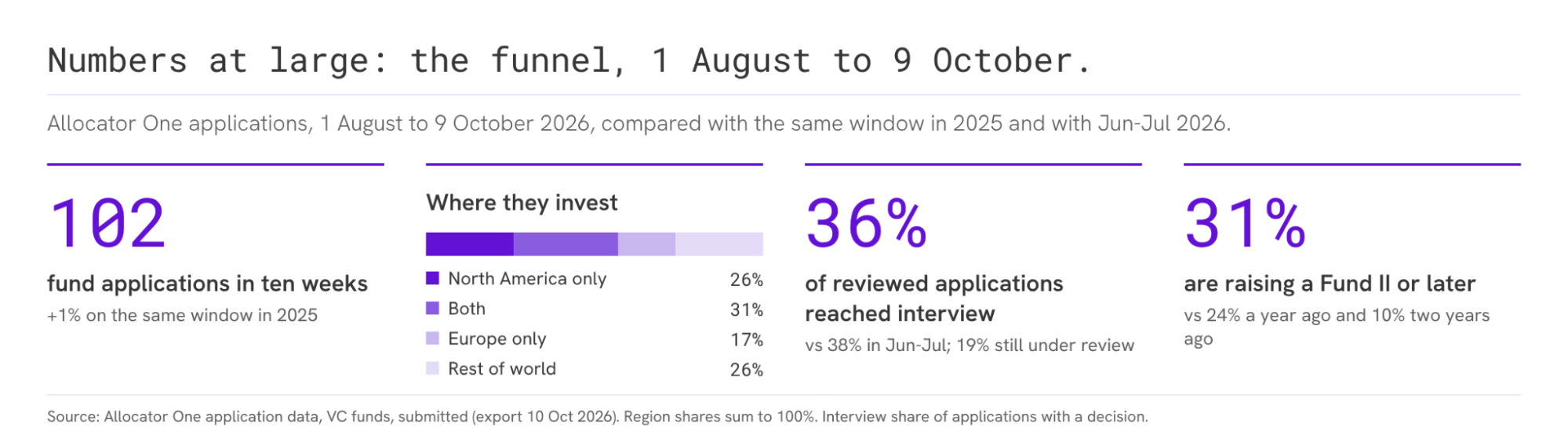
We have around 1,800 managers on our platform, and 650+ applications came in over the last twelve months. That's before the GPs and LPs we meet at events and through referrals.
Every application goes through the same structured process. We look at the numbers first and go deep on the ones that stand out. Only about one in five makes it to a first call.
After a while, patterns start to emerge. Not always the ones you'd expect.
With this many conversations, it felt like a waste to keep what we hear to ourselves. So we decided to start sharing it, every two months.
Welcome to In Between Pitches. Some numbers from our platform, some insights from our conversations, and a few things that have us scratching our heads.
Here's what caught our attention over the last two months.
1. The Solo GP Is Back
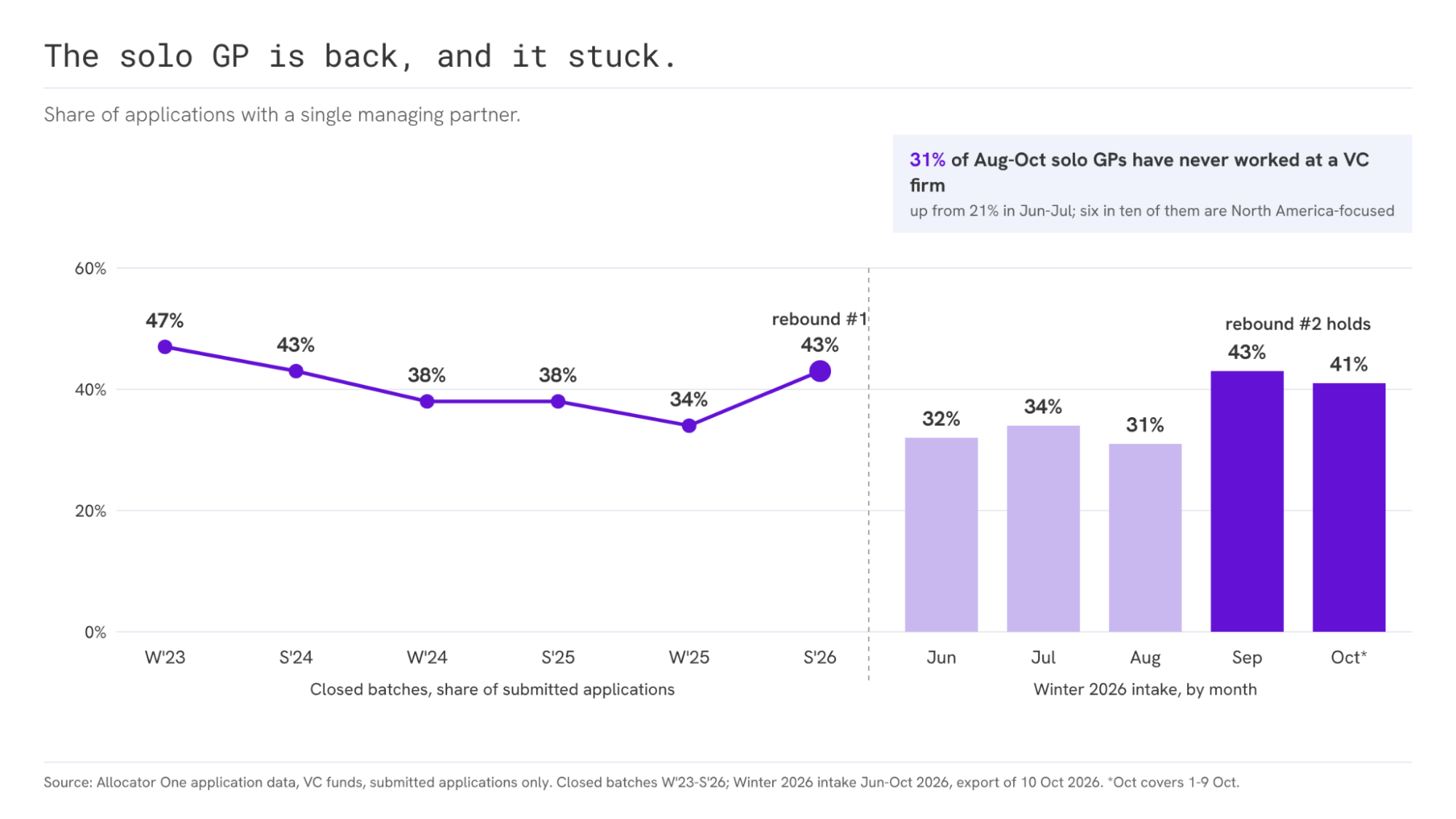
For a while, solo GPs seemed to be disappearing.
Over the past two years, we watched their share of applications fall to around a third. Then came two rebounds, with September recording the highest share since May.
Here's what surprised us: 31% of these solo GPs are former operators, not investors. Most are based in the US.
Why the comeback?
Running a fund alone has become easier. Automation is replacing work that once required a team. Smaller funds are easier to sustain with one GP rather than three. And decisions are faster when you don't need to convince your partners.
Of course, there's key-person risk. But we've also seen what happens when two partners fundamentally disagree.
Our view? We look for outliers. We'd rather back one outlier on their own than three average partners who look good together on a pitch deck.
2. Seed Is Getting Expensive. So Everyone's Going Earlier.
We've been hearing some pretty wild numbers from US managers.
Seed rounds at $60-70M post-money. YC companies raising $5-6M at $50-60M before Demo Day.
We even had to double-check.
PitchBook reported US median seed pre-money valuations of $18.4M in Q1 2026, more than double 2021 levels.
So what's a seed manager supposed to do?
Apparently, become a pre-seed manager.
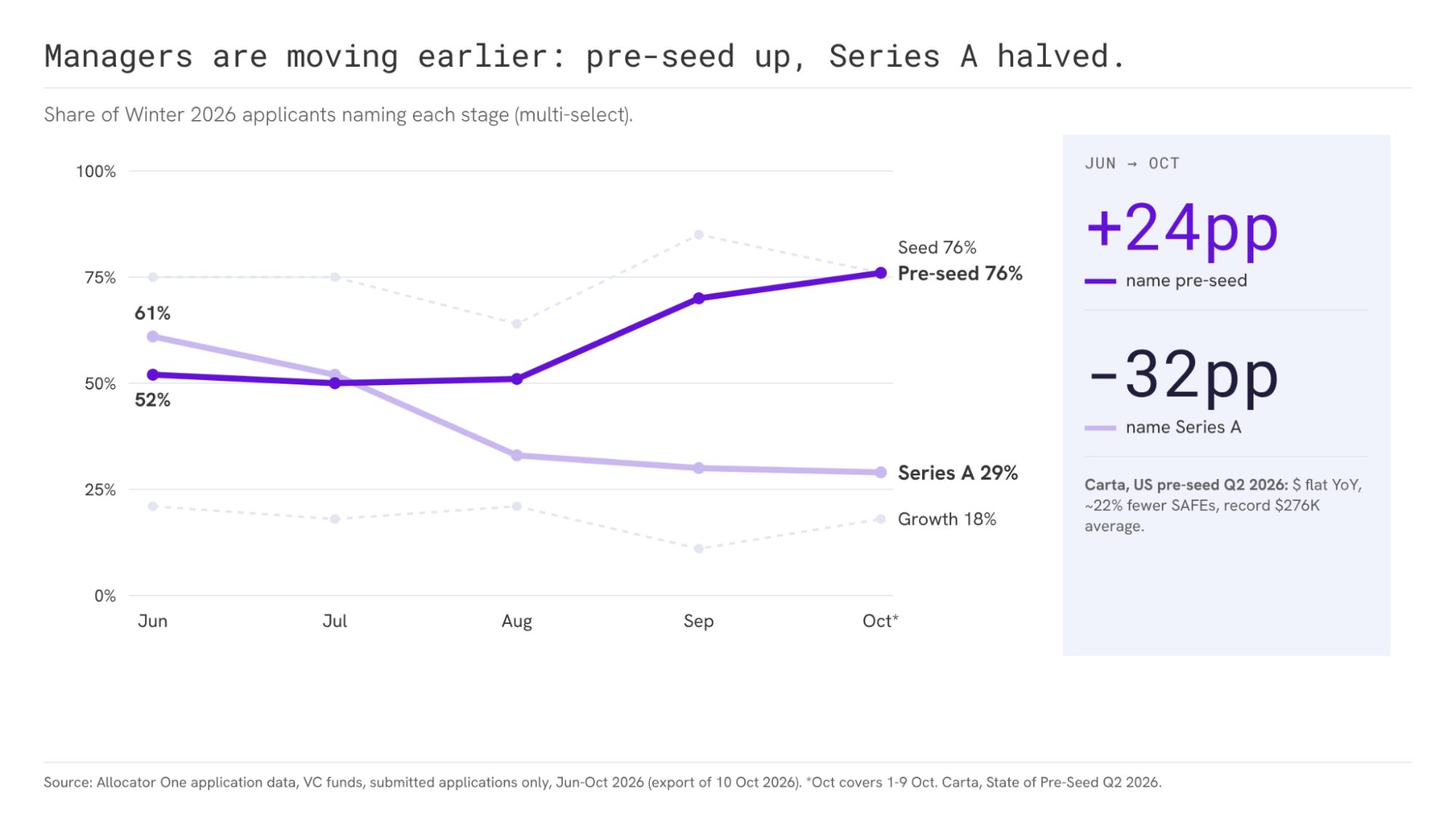
Around two-thirds of applicants since August are pitching pre-seed strategies, up from roughly half before the summer. The share targeting Series A has halved.
But not everyone is following the crowd.
55% of the US seed managers we spoke to think prices have run too far and are investing cautiously. Another 18% are deliberately paying up and taking smaller stakes, arguing that chasing cheap valuations can mean missing the best companies.
And outside the US, the picture looks very different.
In India, GPs report median seed valuations around $8-12M, roughly half the US median. One of them told us that in the US, even pre-seed now starts at $30-40M. Some are building entire strategies around backing Indian founders early and helping them expand into the US.
We're hearing similar approaches from France, Turkey, Italy and the UK.
The interesting part? There isn't really one seed market anymore.
There are markets where founders can name their price, and others where specialist GPs can still build meaningful ownership.
For us, the question isn't whether a manager invests at pre-seed or seed. It's whether the price makes sense for the returns they're trying to generate.
3. Fund II Managers Have One Big Regret
Ask a Fund II manager what they'd do differently. One answer comes up surprisingly often.
"We should have invested more at entry."
Imagine backing a breakout company with $100K, only to realise what the return could have looked like with $300K.
That lesson sticks.
We discuss portfolio construction in around 90% of our first calls and reserves in 80%. Not because we can't read a fund model, but because we want to understand how a GP thinks.
And we're noticing a shift.
Some managers are moving away from traditional reserves altogether. Their reasoning? Follow-on rounds have become so large that smaller funds can barely defend their ownership.
Instead, they're writing larger initial cheques and using SPVs to participate in winners.
In fact, fee-free or 20%-carry co-investment SPVs came up in more than half our GP calls.
It's an interesting trade-off. More ownership upfront, less capital sitting in reserves, and additional exposure for LPs through SPVs.
Of course, it doesn't work for every strategy.
But there's something Fund II managers seem to understand better than most: owning too little of your biggest winner can be an expensive mistake.
4. The AI Question Nobody Can Avoid
And then there's Anthropic. The reported leak of its S-1 filing has everyone talking.
The headline numbers are extraordinary:
- Revenue reportedly grew from $0.4B in 2024 to $4.6B in 2025.
- Operating losses exceeded $8B in 2025.
- Future compute commitments reportedly stand at approximately $518B, around 80% non-cancellable.
That's a lot of future growth to deliver.
And with discussions around a potential $2 trillion valuation, the implications go well beyond Anthropic.
Because when the largest AI companies command extraordinary valuations, that enthusiasm eventually trickles down to seed.
We're already hearing two very different views from managers.
A successful listing could keep valuations elevated for longer. A disappointing one could accelerate a correction, particularly for companies whose valuations depend on AI enthusiasm.
Either way, emerging managers are paying attention.
The question isn't whether AI is creating value. It's how much of that value investors are already paying for today.
So, What Are We Taking Away?
Four different trends, but one common thread. Emerging managers are becoming much more deliberate about how they build their funds.
Some are going solo. Others are moving earlier. Fund II managers are prioritising ownership. And everyone is trying to make sense of AI valuations.
For us, it's less about which strategy a GP chooses and more about whether they've built the right fund around it.
A specialist paying a premium because they have exceptional access? That can make sense.
A pre-seed manager finding opportunities everyone else is overlooking? Also interesting.
But paying top-of-market prices while promising exceptionally disciplined portfolio construction? That's a harder conversation.
The best managers we meet know exactly where their advantage lies. And where it doesn't.
That's what we're looking for.
What We're Watching Next
Three things on our radar: the Fed and ECB rate decisions at the end of October, US economic data and midterms, and Big Tech's Q3 earnings, particularly what they reveal about future AI spending.
We'll be watching how these developments affect the managers we speak to.
And sharing what we learn.
That's the idea behind In Between Pitches. A look into the conversations, numbers and decisions shaping the next generation of venture funds.
Until next time,
Arushi & Elliot, Allocator One Investment Team